Stream inference pipeline
flashdreams.infra.pipeline.StreamInferencePipeline is the low-level model
pipeline used by v2 application model loops. It owns encode, diffuse, and
decode stages plus a per-rollout cache. Application, session, UI, and transport
behavior live above this layer.
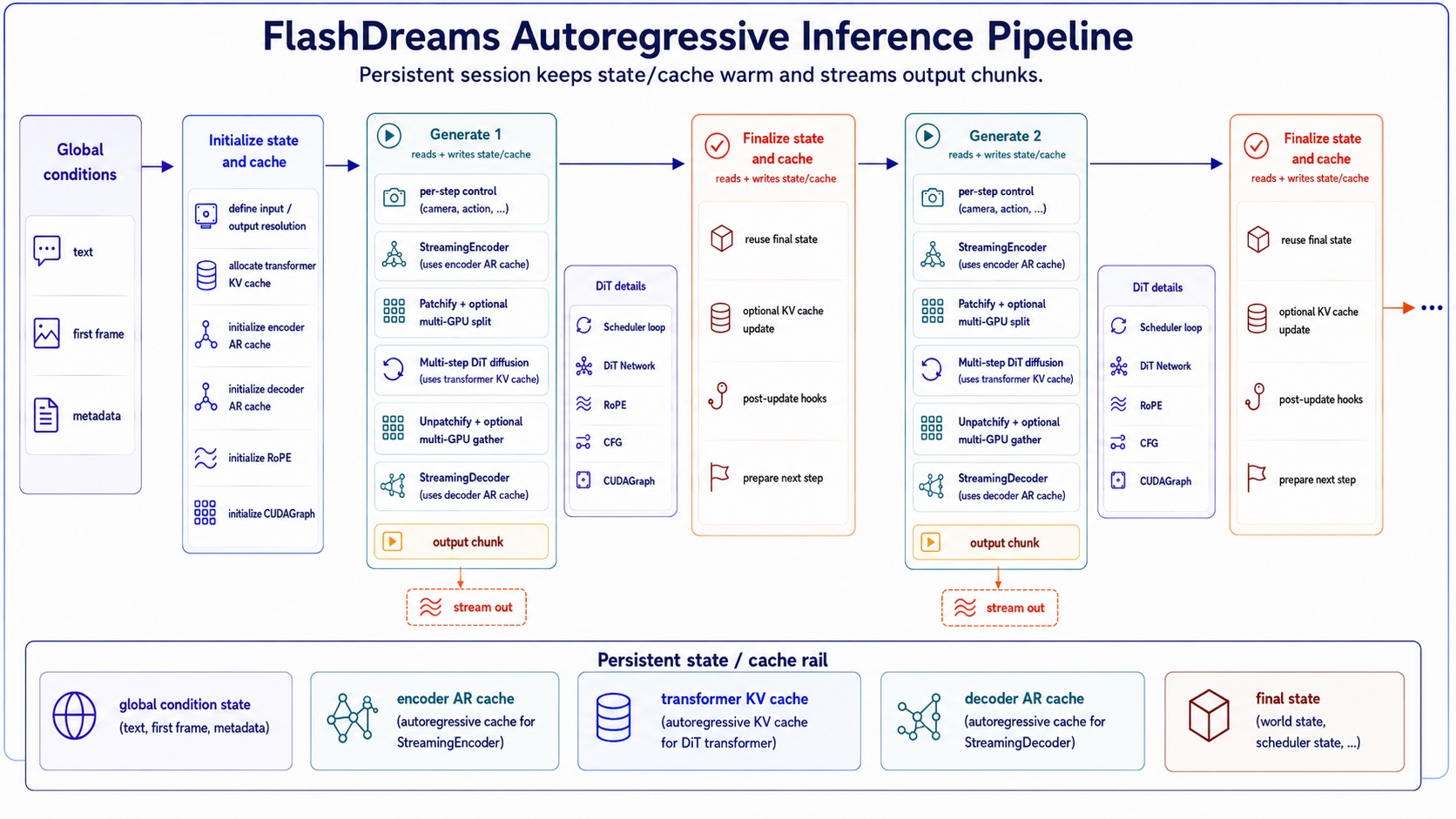
Component boundaries
A pipeline contains:
StreamInferencePipeline
├── encoder (optional per-step StreamingEncoder)
├── diffusion_model
│   ├── transformer
│   │   └── context_encoder (one-shot Encoder)
│   └── scheduler
└── decoder (optional StreamingDecoder)
The two encoder positions are not interchangeable:
| Slot | Runs | Contract | Typical input |
|---|---|---|---|
transformer.context_encoder |
once while building a rollout cache | stateless Encoder |
text or reference image |
pipeline.encoder |
once per autoregressive step | stateful StreamingEncoder |
camera, HD map, action, video chunk |
Set pipeline.encoder=None when no per-step control exists. Set
pipeline.decoder=None to return the clean latent. Use StreamingVideoEncoder
or StreamingVideoDecoder when pixel-video compression ratios and temporal
size mapping are part of the contract.
Rollout lifecycle
Create one cache, then call generate and finalize with consecutive indices:
from flashdreams.infra.pipeline import StreamInferencePipeline

pipeline: StreamInferencePipeline = ...
cache = pipeline.initialize_cache(
    transformer_context={"text_embeddings": text_embeddings},
    encoder_context={},
    decoder_context={},
)

for autoregressive_index, control in enumerate(controls):
    output = pipeline.generate(
        autoregressive_index,
        cache,
        input=control,
    )
    yield output
    metrics = pipeline.finalize(autoregressive_index, cache)
initialize_cache forwards each context dictionary to the matching component's
initialize_autoregressive_cache. Recipe-specific pipeline subclasses may
expose higher-level inputs; for example, a Wan pipeline accepts text and an
optional image and prepares transformer context internally.
generate performs these stages:
- encode a supplied per-step input;
- run the scheduler and transformer denoising loop;
- decode the clean latent when a decoder exists;
- retain the diffusion final state on the cache.
finalize consumes that final state and advances the autoregressive model/cache
for the next step. Use the same cache and index for both calls. The base class
rejects skipped, repeated, or mismatched indices. When synchronized profiling
is enabled, finalize returns stage timings and GPU-memory metrics; otherwise
it returns None.
An application does not always own this loop directly. The V2V application
accepts a VideoPostProcessorConfig; each model's processor session owns the
pipeline cache and calls generate/finalize after converting and buffering
input chunks. FlashVSR builds its pipeline after the input shape is known,
while SwiftVR keeps a resident pipeline and creates an isolated stream cache.
See Integrate model adapter for a demo
for the paired adapters.
Shape and state rules
Outside the transformer network, video tensors are normally pre-patchify
[B, C, T, H, W]. Inside the network they are token sequences such as
[B, L/cp, C]. The transformer owns patchify/context-parallel split and the
inverse gather/unpatchify boundary; callers should not duplicate it.
Caches mirror component ownership:
- pipeline cache: encoder, transformer, decoder caches plus the latest final diffusion state;
- transformer cache: encoded context, RoPE state, and network cache;
- network cache: model-specific K/V or recurrent state.
Allocate caches per rollout or session. Do not share mutable caches across sessions, and rebuild them when shape or context changes.
Configure, then instantiate
from flashdreams.infra.diffusion.model import DiffusionModelConfig
from flashdreams.infra.diffusion.scheduler.fm import FlowMatchSchedulerConfig
from flashdreams.infra.pipeline import StreamInferencePipelineConfig

pipeline_config = StreamInferencePipelineConfig(
    name="my-model",
    encoder=MyStreamingEncoderConfig(),
    diffusion_model=DiffusionModelConfig(
        transformer=MyTransformerConfig(),
        scheduler=FlowMatchSchedulerConfig(),
    ),
    decoder=MyStreamingDecoderConfig(),
)

pipeline = pipeline_config.setup().to("cuda").eval()
Subclass the pipeline only when the public cache-initialization behavior must change. Most integrations should compose existing component contracts and keep model-specific logic in the integration.
Reference configs include Self-Forcing for uncontrolled streaming T2V, LingBot-World for per-step camera control, and Wan 2.1 for single-step bidirectional generation.
Pipeline-backed V2V processors include FlashVSR and SwiftVR. They keep application-level video handling independent from each model's tensor layout, cache initialization, buffering, and flush behavior.